
Blog
Durable Weatherproofing Solutions for Historic Frames: Best Approaches for Period Homes
When it comes to durable weatherproofing solutions for historic frames, one statistic stands above all others as the most compelling case for action: less than a quarter of the heat lost through a typical traditional window escapes by conduction through the glass, with the overwhelming majority lost through draughts and air infiltration. For owners of period properties across Cheshire, this means that carefully applied weatherproofing, rather than wholesale window replacement, is the single most powerful step toward warmth, comfort, and authenticity.
Key Takeaways
| Question | Answer |
|---|---|
| What are the best durable weatherproofing solutions for historic frames? | Draft proofing with invisible timber-integrated seals, slimline vacuum glazing, and carefully selected conservation-approved sealants are the most effective and heritage-sensitive approaches. |
| Will weatherproofing damage the character of my historic sash windows? | No. Properly executed weatherproofing uses discreet seals integrated into the original timber beads, leaving the period character entirely intact. Our restoration process is designed to preserve every original detail. |
| Can Grade II listed buildings receive weatherproofing upgrades? | Yes. Conservation-approved materials and slimline glazing solutions can be installed in listed buildings with careful navigation of planning constraints. |
| Is it better to repair historic frames or replace them? | Our approach is to repair where possible and replace only where necessary. Most historic frames can be stabilised, re-sealed, and returned to excellent performance without replacement. |
| What weatherproofing options exist for sash windows specifically? | Draft sealing within the sash box, weather stripping at meeting rails, slimline double glazing inserts, and secondary glazing are the principal solutions for historic sash window insulation. |
| How long do weatherproofing seals last on historic timber frames? | With quality materials and correct installation, modern draught seals on timber sash windows can last many years before requiring inspection or light maintenance. |
| Does weatherproofing improve the security of historic windows? | A comprehensive programme can include security upgrades alongside weather sealing. See our sash window security services for discreet hardware options that respect original aesthetics. |
Why Durable Weatherproofing Solutions for Historic Frames Matter More Than Ever
Period homes across Cheshire represent an irreplaceable part of England’s architectural history. Their original timber sash frames, glazing bars, and sash boxes were crafted with remarkable precision, and they deserve the same care today.
Yet the reality of life in a Victorian or Edwardian townhouse is that draughts, damp ingress, and heat loss can make daily comfort a genuine struggle. With energy costs remaining a pressing concern for homeowners, the case for investing in durable weatherproofing for historic frames has never been stronger.
The good news is that the two goals, preserving heritage and achieving modern performance, are not in conflict. They are, in fact, entirely compatible when the right solutions are chosen and applied with skill and respect for the original fabric.
We believe that every sash window tells a story. Our role is to ensure that story continues, while making your home warmer, quieter, and more comfortable throughout every season.
Understanding the Unique Challenges of Weatherproofing Historic Frames
Historic timber frames present a specific set of challenges that do not apply to modern uPVC or aluminium windows. The materials are organic, they move with temperature and humidity, and the joinery is often over a century old.
The primary points of air and water ingress in a sash window are typically the gaps between the sashes and the frame, the meeting rail junction, the parting beads, and the interface between the frame and the surrounding masonry. Each of these requires a different approach, and each demands a solution that will flex and endure alongside the timber as it moves over the years.
- Gaps at the sash-to-frame junction (sides and bottom)
- The meeting rail, where upper and lower sashes overlap
- The sash box interior, where pulleys and weight pockets create additional air pathways
- The external interface between the frame and the masonry surround
- Any areas of rotten or degraded timber that have opened up over time
Understanding these points is the foundation of any effective, durable weatherproofing programme for historic frames. Without this diagnostic step, even the best materials will underperform.
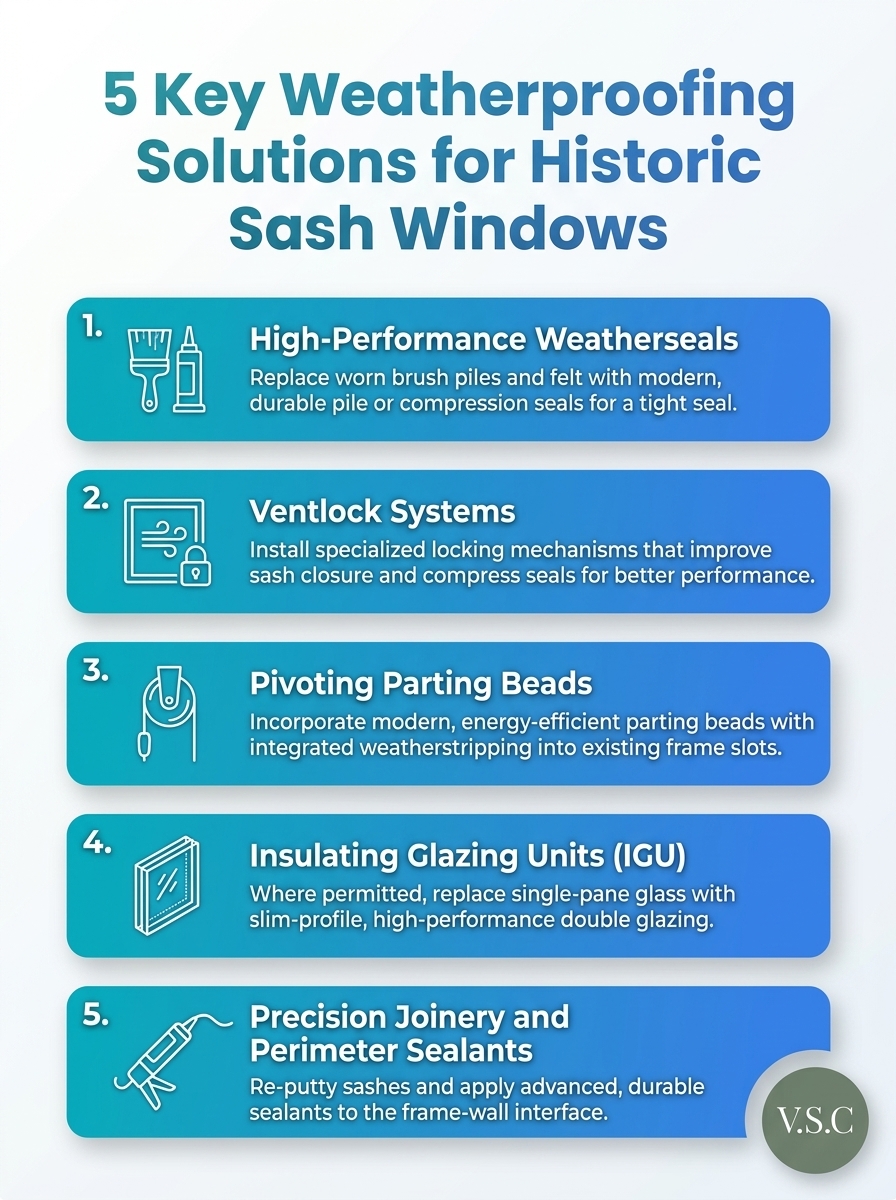
This infographic highlights five essential weatherproofing methods for historic sash windows. It helps preserve historic frames while improving energy efficiency.
The Best Durable Weatherproofing Solutions for Historic Frames: An Overview
Not all weatherproofing approaches are equally suited to period timber. The solutions that perform best over the long term are those that work with the material rather than against it. Here is a clear overview of the principal options available to owners of historic sash windows in Cheshire.
| Solution | Best For | Heritage Impact | Performance Benefit |
|---|---|---|---|
| Draught proofing seals | All historic frames | Invisible when installed | Significant air infiltration reduction |
| Slimline vacuum glazing | Original sash rebates | Fits original frame dimensions | Thermal and acoustic improvement |
| Frame stabilisation and repair | Degraded or rotten timbers | Preserves original material | Closes structural gaps |
| Conservation sealants at masonry interface | Frame-to-wall junction | Flexible, breathable options available | Prevents damp ingress |
| Secondary glazing | Listed buildings with strict planning | Reversible, no alteration to original | Strong thermal and acoustic benefit |
Did You Know?
Windows can contribute up to 40% of envelope heat losses and around 9% of total building energy consumption due to air leakage, as measured by whole-building blower-door testing.
Source: Oak Ridge National Laboratory (ORNL)
Draft Proofing and Weather Sealing: The Foundation of Durable Weatherproofing for Historic Frames
Draught proofing is, without question, the most impactful single intervention available for historic timber sash windows. It addresses the dominant source of heat loss and discomfort directly, and when executed well it leaves no visible trace on the original joinery.
Our restoration process stabilises original frames, replaces rotten timbers, and integrates modern weather seals without compromising historic charm. The seals we use are fitted into the existing timber beads, maintaining the sash’s original profile and appearance while dramatically reducing cold air infiltration.
The draught proofing process addresses every junction in the window:
- The top sash to the top rail: A concealed seal prevents air movement at the uppermost sash junction.
- The meeting rail: A continuous pile seal is installed along the overlapping meeting rails to close what is often the largest gap in the window.
- The side channels: Brush pile seals run the full height of the sash box, eliminating the side gaps that allow cold air to track down into the room.
- The bottom rail to the sill: A compression seal closes the gap between the lower sash and the window board or sill.
The result is a window that operates as smoothly as before, looks entirely as it always has, and performs as a genuinely durable weatherproofing solution for the historic frame it protects.
Whether you need full replacements, double glazing, or careful restoration, we ensure every detail respects original designs. Draught proofing is almost always our first recommendation for any period property, precisely because the returns are so significant and the disruption to original fabric is so minimal.
Slimline Double Glazing as a Durable Weatherproofing Solution for Historic Frames
Where thermal performance needs to go beyond what draught sealing alone can achieve, slimline glazing options offer an exceptional path forward. Technologies such as Fineo vacuum glazing are engineered to fit within the original glazing rebates of a sash window, sitting within the same dimensions as the original single pane.
This matters profoundly for period homes, where the slim sight lines and the visual proportions of the glazing bars are as much a part of the character as the brickwork or the cornicing. A conventional double-glazed unit simply cannot fit within these dimensions without altering the frame. Slimline vacuum glazing can.
The benefits extend well beyond weatherproofing. Reduced condensation, improved acoustic insulation, and noticeably warmer glass surfaces all contribute to a transformed experience of the room, while the window itself remains, to every outward appearance, exactly as the original architects intended.
We install slimline double glazing within original sash boxes, carefully assessing each frame’s condition and rebate dimensions before recommending a specific product. Our approach is always to match the glazing to the window, never the other way around.
Durable Weatherproofing Solutions for Grade II Listed Historic Frames
Owners of Grade II listed properties face an additional layer of complexity when seeking to improve their windows. Any alteration to a listed building requires careful consideration of planning consent, and the range of permissible interventions is more constrained than for unlisted period homes.
However, durable weatherproofing solutions for historic frames in listed buildings do exist, and they can be highly effective. The key is selecting materials and methods that are both conservation-approved and genuinely performant.
Our team navigates planning constraints to safeguard character while improving thermal performance. We work closely with conservation officers where required, ensuring that every intervention meets both regulatory expectations and the practical needs of the homeowner.
“We navigate planning constraints to safeguard character while improving thermal performance. Conservation-approved materials and slimline glazing options like Fineo provide insulation without altering the historic appearance.”
For Grade II listed buildings, the preferred durable weatherproofing solutions typically include:
- Draught proofing with seals that leave no visible alteration to the frame or sashes
- Slimline vacuum glazing in original rebates, subject to local planning guidance
- Secondary glazing installed on the room side of the window (generally reversible and therefore permissible)
- Frame consolidation using lime-compatible fillers and responsibly sourced timber for any repairs
We offer tailored double glazing solutions for Grade II listed buildings, covering every stage from initial consultation through to installation and finishing. Every project is carried out with sustainability in mind, using eco-friendly materials and ethical practices.
Frame Repair and Stabilisation: The Prerequisite for Lasting Weatherproofing
No weatherproofing seal, however well specified, will perform durably if the frame it is applied to is structurally compromised. Rotten timber, misaligned sashes, and damaged glazing bars all create pathways for air and water that seals cannot reliably close.
This is why our approach begins with a thorough assessment of each frame’s condition. We identify areas of rot, assess the integrity of the joints, and check the alignment of both sashes before any weatherproofing work commences.
Where timber is found to be degraded, we repair it using appropriately sourced materials. Our commitment to responsibly sourced timber means that every repair we make is in keeping with both the material character of the original window and our broader sustainability principles.
Our approach is to repair where possible, replace only where necessary, and always maintain the character that makes period homes unique. This philosophy applies as much to individual sections of moulding as it does to the decision of whether a whole sash requires renewal.
Once the frame is stable and sound, the weatherproofing solutions we apply will perform as intended, year after year, as the timber moves through seasonal cycles of expansion and contraction. You can explore the full scope of common sash window issues and how they affect weatherproofing to better understand the diagnostic process.
Security Upgrades That Work Alongside Weatherproofing for Historic Frames
A comprehensive approach to historic frame performance does not end with thermal and moisture considerations. Security is an equally important dimension, and one that is too often treated as an afterthought in period property renovation.
We blend security enhancements with original aesthetic integrity. Hardware upgrades, locking mechanisms, and reinforcing measures can be specified and installed in a way that is entirely discreet, adding meaningful protection without introducing any visual element that is out of keeping with the window’s character.
The relationship between security upgrades and durable weatherproofing for historic frames is also practical. Improved locking mechanisms keep sashes firmly closed against the seals, maximising the performance of any draught proofing that has been installed. A window that can be held tightly shut at multiple points along its meeting rail and side channels will invariably outperform one that relies on a single fastener.
Did You Know?
The ENERGY STAR air leakage requirement for exterior storm windows is set at ≤ 1.5 cfm/ft², providing a concrete performance benchmark that highlights just how precise and measurable effective weatherproofing for historic frames must be.
Source: ENERGY STAR
From security assessments through to full installation, our team handles every element of the upgrade. All work is carried out with the same meticulous workmanship and respect for the original joinery that defines every project we undertake. Learn more about our sash window security services and how they complement a wider weatherproofing programme.
Our Philosophy: Crafted for Tradition, Built for Today
With over 20 years in business and more than 50 years of combined team experience, we bring both depth of knowledge and genuine respect for architectural history to every project we undertake. Victorian sash windows in Cheshire bring timeless beauty to homes while improving comfort, and our work is always guided by that dual purpose.
Our expert team blends traditional craftsmanship with eco-friendly methods to create windows that preserve history and add modern benefits. We have enhanced comfort without compromising on authenticity across hundreds of period properties throughout Cheshire, and our portfolio stands as evidence of what is possible when heritage and modern performance are treated as equal priorities.
We’ve enhanced comfort without compromising on authenticity. From the first consultation to the final polish, we work closely with our clients to ensure every detail is finished to perfection.
The materials we specify are chosen with equal care for their sustainability and their performance. Responsibly sourced timber for all repair work, flexible sealants that breathe with the building, and glazing products that carry genuine thermal credentials are all part of our standard specification. We never treat eco-friendly practice as an optional extra; it is embedded in everything we do.
Durable Weatherproofing Solutions for Historic Frames Across Cheshire
Our work extends across the full breadth of Cheshire, from the historic city of Chester through to Macclesfield, Warrington, Knutsford, Wilmslow, Sandbach, Alderley Edge, and beyond. Each area of the county presents its own microclimate challenges, and our weatherproofing recommendations are always informed by local knowledge as well as technical expertise.
Period homes in Cheshire’s market towns and village centres often face particular challenges: exposed positions, older masonry construction that moves more freely with temperature change, and conservation area designations that add planning considerations to every project. We understand these conditions intimately, having worked across the region for two decades.
- Sash window weatherproofing in Chester, including discreet sealing for listed townhouses
- Restoration and weatherproofing in Macclesfield, serving the area’s extensive Victorian terraced stock
- Historic frame weatherproofing in Warrington, with a focus on heritage craft and modern performance
- Durable weatherproofing for Knutsford’s period homes, including draft-proofing and slimline glazing
- Sash window services in Wilmslow for Victorian and Edwardian properties
- Heritage sash window restoration in Alderley Edge
- Weatherproofing and restoration in Sandbach, respecting the town’s historic character
Our portfolio showcases Victorian sash windows restored and installed across Cheshire, in properties ranging from Grade II listed townhouses to unlisted Victorian terraces and Edwardian semi-detached homes. The common thread across every project is our commitment to solutions that are both genuinely durable and genuinely faithful to the original architecture.
What to Expect From the Process: From Assessment to Final Polish
Every project begins with a thorough on-site assessment. We examine each frame in detail, identifying points of air and water ingress, assessing the condition of the timber, checking sash alignment and balance, and discussing the homeowner’s priorities and any planning considerations that apply.
From that assessment, we develop a tailored programme of durable weatherproofing solutions for the specific historic frames in front of us. There is no standard package. Every window, every frame, and every property is different, and our recommendations reflect that.
The work itself is carried out by experienced craftsmen who treat each element of the original joinery with respect. Seals are fitted with precision. Repairs are executed with materials that are appropriate to the period and the specification. Glazing is installed with attention to both performance and appearance.
From the first consultation to the final polish, we work closely with our clients to ensure every detail is finished to perfection. Our service lifecycle covers the full journey of a window, from structural repair through weatherproofing and glazing to security upgrades and ongoing maintenance advice.
You can view our completed work in our project gallery, or read through our frequently asked questions for more detail on the process and what to expect.
Valuable Investment
Durable weatherproofing solutions for historic frames represent one of the most valuable investments a period homeowner can make. The combination of draught proofing, frame stabilisation, slimline glazing, and conservation-approved sealants can transform a draughty, uncomfortable historic window into a high-performing, characterful feature that contributes to the warmth and authenticity of your home in equal measure.
Our approach is always guided by the principle that the best outcome is one where performance is improved and character is preserved. We repair where possible and replace only where necessary. We use responsibly sourced timber and eco-friendly materials throughout. And we work with the care and precision that the craftsmanship of these original windows deserves.
We believe that every sash window tells a story. Our role is to ensure that story continues for another century, with every joint sealed, every sash running freely, and every detail finished to the standard the original craftsmen would have recognised and respected.
To discuss durable weatherproofing solutions for your historic frames, please get in touch with our team. We are ready to carry out a full assessment and develop a programme that is right for your property, your budget, and your home’s unique heritage
Frequently Asked Questions
What are the most durable weatherproofing solutions for historic sash window frames?
The most durable weatherproofing solutions for historic frames combine concealed draught seals integrated into the original timber beads, slimline vacuum glazing where the rebate allows, and frame consolidation using appropriate timber and sealants at masonry interfaces. These approaches address all the principal pathways for air and water ingress while remaining fully compatible with the period character of the window.
Can I weatherproof a sash window without replacing it?
Yes, in almost all cases. Effective draught proofing and frame stabilisation can dramatically improve the performance of an original sash window without any need for replacement. Our approach is always to repair where possible and replace only where genuinely necessary, preserving as much original fabric as the condition allows.
Is weatherproofing a Grade II listed sash window allowed?
Draught proofing using concealed seals that leave the window visually unchanged is generally permissible for listed buildings and does not typically require listed building consent, though this varies by local authority. Slimline glazing upgrades may require consent, and we navigate those planning conversations on behalf of our clients as part of our service.
How much does weatherproofing a historic sash window actually improve comfort?
The improvement can be substantial. Since the majority of heat lost through a traditional window escapes via draughts rather than conduction through the glass, closing those air pathways with durable weatherproofing seals addresses the dominant source of discomfort. Most homeowners notice an immediate and significant reduction in cold draughts following a professional draught proofing treatment.
How long do weatherproofing seals last on timber sash windows?
High-quality pile and compression seals installed by experienced craftsmen typically last many years before requiring inspection. Timber movement through seasonal cycles will gradually affect seal performance, so we recommend periodic maintenance checks as part of a good stewardship approach to historic frames. Our maintenance guidance covers the steps homeowners can take to extend the life of their weatherproofing.
Is slimline double glazing worth it for historic frames?
For homeowners seeking thermal improvement beyond what draught sealing alone provides, slimline vacuum glazing is an excellent investment. It delivers meaningful insulation performance while fitting within original frame dimensions, so the proportions and character of the historic window are preserved entirely. The combination of draught sealing and slimline glazing represents the most comprehensive durable weatherproofing solution available for historic frames today.
What is the difference between weatherproofing and full sash window restoration?
Full sash window restoration addresses the structural condition of the entire frame and sash assembly, including timber repair, realignment, rebalancing of weights and cords, and finishing. Weatherproofing is one component within that process, covering the sealing and glazing elements that control air and moisture. Both are best treated as part of a single, coordinated programme rather than separate interventions, which is exactly how our expert team approaches every project.
Require Assistance with Repairs?
Contact us now on 01606 333943
Mobile: 07789 598238
Email: info@victoriansash.net